
Advanced Lithium Battery Dry Room Enclosures: Ensuring Ultra-Low Humidity Environments
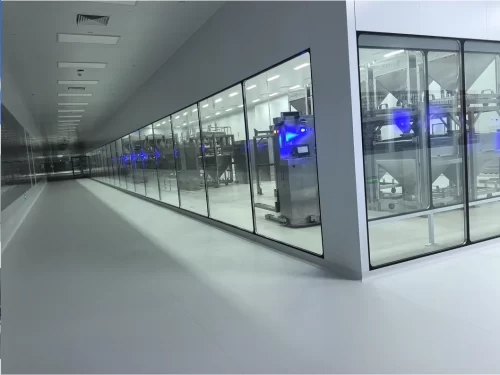
1. The Critical Role of Ultra-Low Humidity Control in Battery Operations
Hygroscopic dust suppression requires a complete systems approach integrated from structural elements to exhaust mechanisms, distinct from standard cleanroom designs.
- Safety-Related Humidity Management: Moisture accelerates electrolyte degradation in lithium-ion batteries, potentially causing thermal runaway. Our systems use forced-air drying and continuous sub-20% RH monitoring to maintain battery integrity.
- Electrostatic Control: Low humidity environments (below 40% RH) minimize surface static charge accumulation. We specify specialized grounding protocols and conductive wall panels that reduce ESD events by >85% compared to conventional dry rooms.
- Material Degradation Prevention: Damp atmospheres damage sensitive lithium components and electrical insulation. Farclean’s exclusive Polyurea Vapor Barrier Technology combines impermeable substrate and active drying agents for long-term stability.
- Regulatory Compliancy: FDA 21 CFR Part 211.105 requires controlled moisture environments for electrochemical devices. Our systems provide documented certification against ISO 14644-4 and EU GMP Annex 1 standards.
- Maintenance Efficiency: Ultra-dry conditions prevent the need for surface cleaning chemical applications in enclosed battery systems, reducing maintenance protocols by 40-60%.
2. Comparative Analysis of Advanced Dry Room Features versus Conventional Approaches
The table below outlines engineered solutions specifically designed for lithium battery applications and typical commercial dry room implementations:
| Component Feature | Farclean Lithium-Specific Design | Standard Commercial Dry Room Method” |
|---|---|---|
| Wall Panel Vapor Resistance | Perm rating < 0.001 ng/(pcm²hr) with active desiccant layers | Typical commercial systems achieve 5-15 perm with no desiccant integration |
| Air Filtration Cycles | Filtered room air 15+ cycles/minute continuously | Outside air cycles organized in batches (2-4 cycles/hour) |
| Environmental Stability | <0.5% RH fluctuations with auto-compensating exhaust dampers | 7-10% RH variation with passive exhaust controls |
| Cleanable Interfaces | Custom powder-coated aluminum frames for effortless dust wiping as material | Standard dry room setups utilize sheet metal with cleaning dead-spaces |
| Integration with HVAC System” | Modular integrated AHU with lithium-specific filtration and bypass valves | Off-the-shelf commercial AC units with standard wet discharge |
3. Key Engineering Considerations for Lithium Enclosure Optimizations
- Temperature-Dependent Humidity Control Systems: Incorporate highly responsive thermal sensors paired with humidity-based VFD-controlled exhaust modulation. This automatically adjusts air exchange based on real-time battery temperature, humidity conditions, and seasonal environmental cycles.
- Battery-Specific Air Filtration Sequencing: Implement progressive filtration stages from pre-filter to final HEPA, with battery-integrated bypass slots removing particulate directly at the power source. This eliminates airborne contaminants at critical charging port contacts.
- Energy Recovery Ventilation Systems: Advanced lithium battery installations require constant ultra-dry air without energy loss. Our Counter-Flow Energy Recovery Units transfer 75% of exhaust energy to incoming air while maintaining complete separation of conditioned air streams.
- Impervious Vapor Sealing: Beyond standard wall gaskets and sealing compounds, we utilize tape-tested abutting panel edges and compressed bead sealing with special polyacrylic sealant around all penetrations. This establishes a continuous vapor-resistance barrier equivalent to 12 feet of dense rock wool insulation.
- Integrated Dew-Point Monitoring Array: Deploy continuous membrane hygrometers throughout the chamber infrastructure for absolute humidity tracking, triggering automatic safety protocols when dew points exceed specified thresholds.
Is Your Current Dry Room System Sub-Optimal?
Farclean offers end-to-end lithium-specific facilities — from site assessment and 3D thermodynamic modeling to certified installation of temperature-stabilized wall panels factory-integrated with specialized air handling systems.
Download Our Lithium Storage Integration Guide to learn about current FDA cGMP requirements for lithium battery storage environments.
Related Posts
How Hermetically Sealed Cleanroom Doors Prevent Differential Pressure Loss | Farclean Systems 2026-09-10
Positive vs. Negative Pressure Cleanrooms: Biopharma Containment Solutions 2026-09-10
Steps to Execute Cleanroom EPC Projects According to EU-GMP International Standards 2026-09-10
Turnkey Solutions for Pharmaceutical and Medical Device Factory Construction 2026-09-10
Supply Chain Management Best Practices in Greenfield Biotech Development 2026-09-10
Latest Solutions
How Hermetically Sealed Cleanroom Doors Prevent Differential Pressure Loss | Farclean Systems
2026-09-10
Positive vs. Negative Pressure Cleanrooms: Biopharma Containment Solutions
2026-09-10
Steps to Execute Cleanroom EPC Projects According to EU-GMP International Standards
2026-09-10
Turnkey Solutions for Pharmaceutical and Medical Device Factory Construction
2026-09-10
Supply Chain Management Best Practices in Greenfield Biotech Development
2026-09-10
Latest Products
Precision Stainless Steel Pass Box Solutions | ISO 14644-1 Certified Supplier
2026-09-11
Turnkey Cleanroom Pass-Through Box: Solution for Semiconductor & Bio-Labs
2026-09-11
VHP-Sterilizable Pass-Through Box Manufacturer | VHP-Resistant Specs & Pricing
2026-09-11
ISO Class 5 Electric Interlocking Pass-Through Box | Farclean Manufacturer
2026-09-11
Fast Delivery of Pharma-Grade Pass-Through Boxes | Minimize Installation Costs (2026 Guide)
2026-09-11
Latest Insights
How Energy-Efficient Cleanroom Wall Panels Reduce Operational Costs over 10 Years
2026-09-09
Turnkey Biotech Cleanroom Engineering | Custom Air Filtration & Enclosures
2026-09-09
Cleanroom Procurement Checklist: How to Avoid Unexpected Change Orders
2026-09-09
Turnkey Cleanroom vs. Self-Built EPC: Total Cost of Ownership (TCO) Comparison
2026-09-09
5 Hidden Factors Driving Up Your Cleanroom HVAC and Piping Installation Budget
2026-09-09
Latest News
Advanced Airflow Optimization Techniques to Reduce Cleanroom HVAC Energy Load
2026-09-10
Global Cleanroom Material Price Trends in 2026: Steel, Insulation, and Shipping Forecasts
2026-09-09
Farclean to Showcase Integrated Cleanroom System Samples at Pharmaconex 2026 in Cairo
2026-08-31
Cleanroom Automation Systems Market Outlook 2025–2030: The Digital Transformation of Controlled Environments
2026-08-05
Increasing Demand for ISO Class 5 Cleanrooms in Microelectronics: Powering Next-Gen Semiconductor Manufacturing
2026-08-05