
Turnkey Cleanroom vs. Self-Built EPC: Total Cost of Ownership (TCO) Comparison
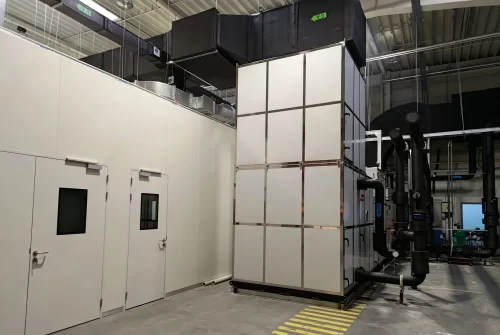
When planning a controlled manufacturing or research environment, facility owners face a critical architectural and financial decision: opting for an integrated turnkey cleanroom engineering solution or attempting a self-built EPC (Engineering, Procurement, and Construction) execution. While a self-managed multi-vendor approach may appear lower in initial direct bids, evaluating the Total Cost of Ownership (TCO) over a 10-to-15-year lifecycle reveals a starkly different financial reality.
As a global leader in full-lifecycle controlled environment solutions, Farclean delivers single-source turnkey cleanroom engineering alongside high-performance modular cleanroom wall panels, specialized doors, pass boxes, and HVAC equipment. Here is a complete analysis comparing Turnkey Cleanroom vs. Self-Built EPC models across capital expenditure, operational efficiency, qualification risk, and lifecycle maintenance.
Request a Turnkey Cleanroom Project Evaluation
Understanding TCO in Cleanroom Infrastructure
Total Cost of Ownership in cleanroom engineering encompasses far more than initial structural installation (CapEx). It calculates the cumulative lifetime expenditure across four primary pillars:
- Direct Capital Expenditure (CapEx): Initial design fees, civil works, HVAC air handling, modular panel fabrication, high-purity process piping, and cleanroom hardware.
- Indirect CapEx & Opportunity Cost: Schedule delays, field rework, vendor interface management, and delayed market entry.
- Operational Expenditure (OpEx): Ongoing energy consumption, HVAC air balancing, air filter replacements, leak testing, and routine maintenance.
- Compliance & Qualification Costs: DQ/IQ/OQ/PQ validation protocol execution, recalibration, and regulatory audit compliance (cGMP, EU GMP, ISO 14644).
Turnkey vs. Self-Built EPC: Total Cost Breakdown
| Cost Matrix | Integrated Turnkey Solution (Farclean) | Self-Built EPC / Multi-Vendor Model |
|---|---|---|
| Initial Engineering & Procurement | Unified 3D BIM design, integrated product manufacturing, direct factory pricing, zero vendor markups. | Multiple design fees, fragmented sub-contractor markups, potential specification mismatches. |
| Construction & Timeline Risk | Pre-engineered panel penetrations, single-team project management, 20-30% faster project delivery. | Interface conflicts between HVAC, civil, and piping contractors; frequent field rework and schedule slippage. |
| Energy Efficiency & OpEx | Precisely matched AHU loads, low-leakage sealed envelope, optimized VAV/VFD controls, lower utility bills. | Over-specified HVAC fans, air leakage at unaligned panel joints, higher long-term power consumption. |
| Validation & Audit Risk | Turnkey qualification documentation included; seamless ISO and GMP compliance guaranteed. | Finger-pointing between vendors during validation failures; costly third-party compliance fixes. |
4 Hidden Financial Pitfalls of Self-Built EPC Cleanrooms
1. The Hidden Cost of Interface Management
In a self-built model, procuring wall panels from Vendor A, HVAC systems from Vendor B, and process piping from Vendor C creates extensive alignment gaps. When air leakage occurs or ceiling grid cutouts miss structural tolerances, contractors assign blame to one another. Managing multiple interfaces consumes internal engineering bandwidth and forces expensive change orders on-site.
2. Delayed Time-to-Market
In pharmaceutical, biotech, and semiconductor manufacturing, time-to-market directly impacts revenue. Uncoordinated sub-contractors frequently extend the construction phase by weeks or months. For high-margin products, a 60-day validation delay can cost millions of dollars in lost market opportunity—far exceeding any initial savings achieved by piecemeal sourcing.
3. Escalated Energy and Operational Waste
Cleanroom HVAC operations represent up to 70% of a facility’s total energy spend over its operating life. Self-built systems often suffer from mismatched air handling sizing and unsealed wall-to-ceiling joints, forcing fan motors to work harder to maintain required differential pressures. Farclean’s factory-integrated modular panel envelopes and optimized AHU designs minimize air leakage, dramatically reducing long-term kilowatt-hour consumption.
4. Validation Bottlenecks and Compliance Friction
Passing regulatory audits requires seamless traceability, precise air balancing, and comprehensive documentation. Fragmented construction leads to unexpected air turbulence, temperature fluctuations, or particle counter spikes during commissioning. Fixing compliance flaws after installation requires costly teardowns and retrofits.
The Farclean Turnkey Advantage
Farclean eliminates lifecycle financial risks by acting as your single point of accountability. By combining proprietary product manufacturing—such as modular cleanroom wall panels, flush doors, cleanroom windows, and pass boxes—with expert turnkey engineering, we guarantee structural integrity, pressure stability, and rapid cGMP/ISO qualification.
- Factory-Direct Integration: Eliminates middleman markups and guarantees perfect fit between wall, ceiling, and mechanical penetrations.
- Precision 3D BIM Clash Detection: Identifies spatial conflicts prior to manufacturing, eliminating on-site cutting and dust contamination.
- Full Lifecycle Support: From initial architectural layout and DQ/IQ/OQ validation packages to routine maintenance and spare parts supply.
Conclusion
While a self-built EPC model may appear cost-effective on initial spreadsheets, the hidden costs of field rework, schedule delays, energy inefficiency, and validation friction make it far more expensive over time. Partnering with Farclean for an integrated turnkey cleanroom solution delivers predictable budgeting, faster facility startup, and optimized Total Cost of Ownership.