
Advanced Airflow Optimization Techniques to Reduce Cleanroom HVAC Energy Load
Advanced Airflow Optimization Techniques to Reduce Cleanroom HVAC Energy Load
HVAC systems are the single largest energy consumer in cleanroom facilities, often accounting for 50% to 70% of total operational electricity costs. To maintain strict ISO 14644-1 cleanliness standards, cleanrooms rely on continuous high-volume air circulation, precise temperature/humidity control, and robust differential pressure maintenance. However, over-designing airflow parameters leads to astronomical energy waste.
At Farclean, as a premier provider of turnkey cleanroom engineering solutions and high-performance cleanroom components, we help facility managers and engineering leads optimize airflow dynamics. Implementing advanced airflow optimization techniques can reduce HVAC energy consumption by 25% to 50% without compromising ISO cleanliness compliance.
1. The Core Drivers of Cleanroom HVAC Energy Consumption
Understanding where energy is consumed is the first step toward optimization. Cleanroom HVAC energy draw is primarily governed by three factors:
- Air Change Rates Per Hour (ACPH): High ACPH demands massive fan power. Fan energy consumption scales cubically with airflow volume ($P \propto Q^3$).
- Conditioning Outdoor Makeup Air: Fresh air intake requires intensive cooling, dehumidification, and heating before entering the clean zone.
- Static Pressure Resistance: High resistance across HEPA/ULPA filters, ductwork bends, and non-flush wall/door transitions forces Air Handling Units (AHUs) to work harder.
2. Advanced Airflow Optimization Strategies
| Optimization Technique | Mechanism of Action | Potential Energy Savings | Implementation Impact |
|---|---|---|---|
| Demand-Controlled Dynamic ACPH | Sensor-based real-time particle monitoring lowers fan speeds during non-operational hours. | 20% – 40% Fan Power | Requires intelligent VFD fan filter units (FFUs) and BMS integration. |
| Mini-Environment Isolation | Enclosing critical processes with localized ISO Class 5 hoods while maintaining background at ISO Class 7/8. | 30% – 50% Overall HVAC Load | Reduces total cleanroom volume requiring high-volume laminar airflow. |
| Optimized Airlock & Leakage Sealing | Installing high-precision flush cleanroom doors and sealed modular wall panels to eliminate exfiltration. | 15% – 25% Makeup Air Energy | Stabilizes differential pressure cascades and reduces treated makeup air loss. |
| Low-Pressure Drop Filtration & Ductwork | Utilizing ePTFE HEPA filters and aerodynamically optimized ducting to lower static resistance. | 10% – 15% Fan Power | Extends filter lifespan while minimizing AHU motor workload. |
3. Key Structural & Product Solutions for Energy Efficiency
Airflow optimization is not merely an HVAC software adjustment; it requires tight integration with the cleanroom’s architectural envelope:
A. Airtight Modular Wall Panels & Flush Ceilings
Uncontrolled air leakage forces makeup air units to overcompensate to maintain positive/negative differential pressure. Farclean’s pre-engineered modular wall panels feature double-gasketed interlocking joints and non-porous surfaces (such as Rockwool or Aluminum Honeycomb cores) that guarantee minimal air loss and smooth, boundary-layer airflow.
B. Ultra-Sealed Flush Cleanroom Doors
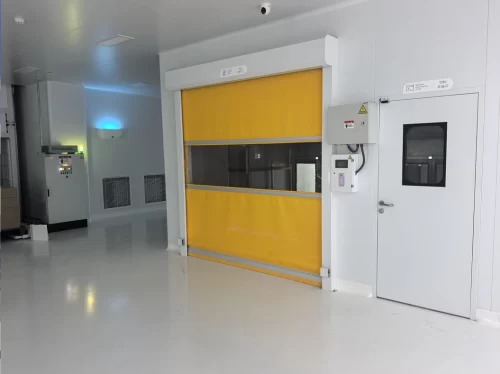
Standard industrial doors create turbulence and air leaks during pressure transitions. Farclean’s flush-mounted cleanroom doors incorporate drop-down bottom seals and silicone gaskets. These prevent air exfiltration between adjacent pressure zones, significantly cutting down makeup air cooling and dehumidification loads.
C. Intelligent Fan Filter Units (FFUs) with EC Motors
Replacing traditional AC-motor FFUs with High-Efficiency Electronically Commutated (EC) motor FFUs allows centralized speed modulation. When integrated with a Building Management System (BMS), airflow can automatically ramp down during night-setback modes.
4. Turnkey Engineering: Balancing Compliance & Energy Savings
Over-specifying ACPH for “safety margin” is an obsolete approach that inflates CapEx and OpEx. Through Farclean’s turnkey engineering service, we conduct Computational Fluid Dynamics (CFD) modeling during the design phase to:
- Map airflow velocity vectors and eliminate dead zones where contaminants settle.
- Optimize the placement of return air risers, cleanroom doors, and FFU grids for maximum sweeping efficiency.
- Right-size the HVAC chiller and AHU capacities to prevent short-cycling and excessive energy consumption.
Partner with Farclean for Energy-Efficient Cleanroom Solutions
Whether you are designing a new pharmaceutical, semiconductor, or medical device facility, or upgrading an existing cleanroom to cut operating costs, Farclean offers full turnkey engineering services alongside high-quality, factory-direct cleanroom products—including modular wall panels, airtight doors, laminar flow hoods, and FFU systems.
Contact our engineering specialists today to analyze your cleanroom airflow layout and receive a tailored HVAC energy reduction proposal.