
Trends in HVAC Energy Optimization for Clean Environments: Sustainable Engineering for Controlled Spaces
Controlled environments and cleanrooms are traditionally among the most energy-intensive facilities in industrial manufacturing, pharmaceutical production, and healthcare sectors. Because strict ISO and GMP standards demand continuous, high-volume air changes and precise temperature-humidity regulation, HVAC systems often consume up to 60% to 80% of a facility’s total energy. Trends in HVAC energy optimization for clean environments have shifted from optional green initiatives to essential engineering mandates. Facility managers and cleanroom operators are under immense pressure to reduce operational expenditures (OPEX) and shrink carbon footprints without compromising stringently maintained contamination boundaries.
Key Drivers Behind Cleanroom HVAC Energy Transformation
Balancing uncompromising particle control with extreme energy efficiency requires a complete rethink of traditional air distribution strategies. Modern sustainable engineering focuses on several core developments that are redefining how cleanrooms are conditioned and ventilated.
1. Variable Air Volume (VAV) and Demand-Controlled Ventilation
Historically, cleanroom ventilation systems ran at a constant, maximum volume 24/7 regardless of actual occupancy or operational load. Modern smart cleanrooms deploy VAV systems integrated with real-time particle counters and occupancy sensors. During idle or low-activity shifts, air change rates are safely scaled back within compliance limits to conserve substantial fan energy.
2. Advanced Heat Recovery Systems
Because cleanrooms require immense quantities of outside make-up air to maintain positive pressure, conditioning raw ambient air requires heavy thermal loads. Integrating high-efficiency run-around coil loops, heat pipe exchangers, or enthalpy wheels allows facilities to reclaim thermal energy from exhaust air streams, drastically reducing chiller and boiler heating/cooling cycles.
3. High-Efficiency EC Fan Motor Arrays
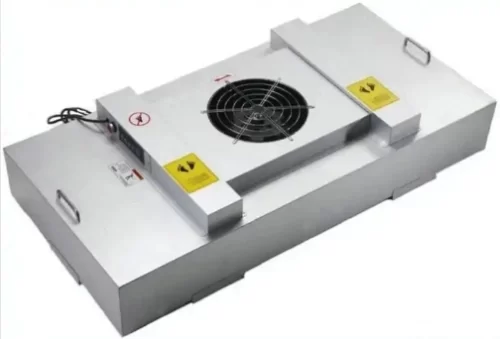
Upgrading from traditional belt-driven centrifugal fans to Electronically Commutated (EC) fan filter unit (FFU) arrays provides superior energy efficiency, smoother airflow modulation, and lower acoustic footprints. Redundant fan arrays also ensure uninterrupted cleanroom integrity even if an individual motor undergoes maintenance.
Engineering Best Practices for Optimizing Cleanroom Air Systems
Implementing energy-saving upgrades requires a systematic approach to architectural layouts, envelope airtightness, and automation. At Farclean, our cleanroom integration methodologies emphasize holistic efficiency:
- Enclosure Airtightness: Utilizing high-performance insulated sandwich panels and airtight cleanroom doors to eliminate structural air leakage, preventing wasted conditioned air loss.
- Optimized Pressure Cascades: Fine-tuning differential pressure cascading between buffer zones and core cleanrooms to avoid excessive, energy-draining over-pressurization.
- Smart Building Management Systems (BMS): Implementing real-time predictive analytics and automated PLC controls to dynamically adjust fan speeds, setpoints, and filtration cycles based on actual environmental telemetry.
Future-Proofing Your Facility with Farclean
Transitioning toward low-carbon, energy-optimized cleanrooms is no longer just about cost-cutting—it is a critical pillar for long-term regulatory compliance and market competitiveness. By combining precision-engineered cleanroom envelopes, modular wall systems, and high-efficiency ventilation support, facilities can achieve peak operational performance.
Partner with Farclean to design, build, and optimize your controlled environment with state-of-the-art infrastructure built for the future.
Ready to lower your facility’s energy consumption while maintaining strict ISO standards? Contact Farclean today to consult with our cleanroom engineering team.