
ESD Safety Standards in Cleanrooms for Electronics Manufacturing
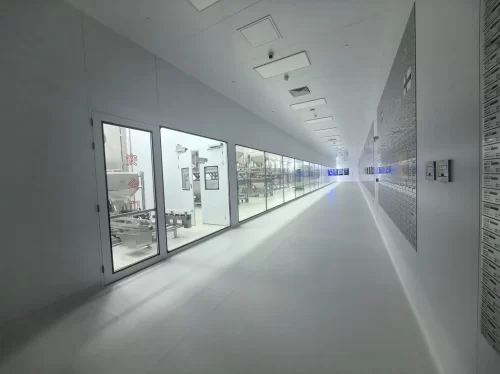
In high-precision electronics, semiconductor fabrication, optics, and surface-mount technology (SMT) manufacturing, controlling airborne particulate matter to ISO 14644 standards is only half the equation. Equally critical—and often far more destructive to product yield—is the prevention of Electrostatic Discharge (ESD).
Modern microchips and sensitive electronic components can suffer catastrophic breakdown or latent failure from static charges as low as 100 volts—or even 10 volts for ultra-sensitive nanoscale devices. Because human perception cannot even feel a static discharge below 3,000 volts, unmanaged electrostatic attraction (ESA) and ESD events silently ruin silicon wafers, printed circuit boards (PCBs), and optoelectronic sensors.
This technical guide details compliance protocols under ANSI/ESD S20.20 and IEC 61340-5-1, electrostatic controls within ISO Class 3–7 cleanrooms, and engineered architectural solutions to maintain static-safe manufacturing environments.
1. Primary Standards Governing Cleanroom ESD Protection
To establish a certified Electrostatic Discharge Protected Area (EPA) within a cleanroom, facility operators adhere to two globally recognized benchmarks:
- ANSI/ESD S20.20 (Electrostatic Discharge Association): Specifies requirements for designing, establishing, implementing, and maintaining an ESD Control Program for electrical and electronic parts susceptible to ESD equal to or greater than 100V Human Body Model (HBM).
- IEC 61340-5-1 (International Electrotechnical Commission): Defines administrative and technical requirements for EPAs across European and Asian electronics supply chains.
Under both standards, all conductive and static dissipative items in the cleanroom—including walls, ceilings, raised floors, furniture, pass boxes, and operator garments—must be bonded to a common ground point (Equipotential Bonding Ground).
2. Surface Resistivity Classifications in Cleanroom Environments
Materials used inside an electronics cleanroom are categorized by their surface electrical resistivity (measured in Ω/sq or ohms per square):
| Material Classification | Surface Resistivity Range (Ω/sq) | Cleanroom Application & Behavior |
|---|---|---|
| Conductive Materials | < 105 Ω/sq | Drains static charges rapidly to ground. Used for copper grounding grids, ESD flooring tiles, and stainless steel work surfaces. |
| Static Dissipative Materials | 105 to 1011 Ω/sq | Optimal for Cleanrooms. Bleeds static off safely and gradually without causing sudden, high-peak spark discharges. Used for anti-static wall panels, ESD PVC curtains, and ESD laminates. |
| Insulative Materials (Forbidden) | > 1012 Ω/sq | High Risk. Holds static charges indefinitely; cannot be grounded. Standard untreated plastics, non-ESD glass, and conventional wall coatings must be excluded from EPAs. |
3. Key Components of an Engineered Cleanroom ESD Control System
A. Static Dissipative Wall & Ceiling Panels
Standard painted steel panels can build up significant static friction as laminar airflow moves across their surfaces. Electronics cleanrooms require antistatic powder-coated steel or aluminum sandwich panels (surface resistivity 106–109 Ω/sq) equipped with integrated grounding clips at every structural joint.
B. Conductive Vinyl Flooring & Copper Grounding Strips
Cleanroom flooring must continuously bleed charges from mobile equipment and operators wearing conductive footwear. Installation involves laying down a copper foil grounding grid beneath conductive PVC tiles, terminated directly to the facility’s earth ground.
C. Ionization Bars in Laminar Flow Zones
Where non-conductive materials cannot be eliminated (e.g., quartz tubes or wafer carriers), corona discharge ionization bars installed below Fan Filter Units (FFUs) generate balanced positive and negative air ions to neutralize localized static charges on non-groundable surfaces.
D. ESD-Safe Material Transfer: Pass Boxes & Carts
Moving sensitive components into the EPA requires stainless steel dynamic pass boxes with continuous grounding bonds, eliminating charge buildup as items cross cleanroom boundaries.
4. Summary Comparison: Standard Cleanroom vs. Electronics ESD Cleanroom
| Engineering Element | Standard Pharmaceutical Cleanroom | Electronics / Semiconductor ESD Cleanroom |
|---|---|---|
| Wall Panel Surface | Smooth, chemical-resistant PVC / HPL or PE powder coat. | Static Dissipative Powder Coating (106–109 Ω/sq) with joint grounding. |
| Flooring System | Seamless coved epoxy or standard PVC. | Conductive / Static Dissipative Vinyl Tile with copper grounding mesh. |
| Air Ionization | Not required. | Pulse DC / AC Air Ionizer Bars at FFU discharge zones. |
| Transfer Equipment | Standard interlocked pass box. | Grounded Stainless Steel Pass Box with anti-static interior lining. |
Build Your Static-Safe Electronics Cleanroom With Farclean
Achieving full ANSI/ESD S20.20 compliance requires integrated cleanroom architecture where wall panels, ceiling grids, doors, and transfer equipment work together as a unified grounded network.
At Farclean, we design and manufacture anti-static modular cleanroom hardware tailored for semiconductor, optical, and SMT manufacturing:
- Anti-Static Sandwich Wall & Ceiling Panels: Engineered static dissipative surface coatings with embedded grounding connectors.
- ESD Stainless Steel Dynamic Pass Boxes & Air Showers: Full metallic grounding integration to eliminate transfer charges.
- Custom FFUs with Optional Ionization Bars: Uniform laminar airflow paired with active static neutralization.