
What Is an FFU (Fan Filter Unit)? Working Principle & Cleanroom Benefits
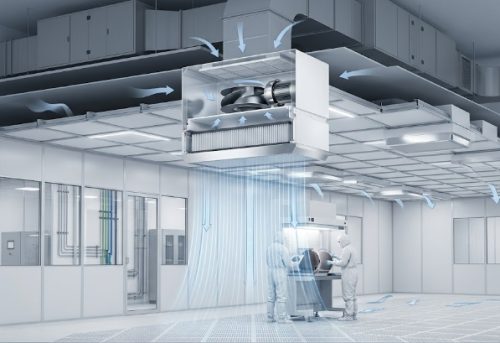
In the world of controlled environments—ranging from semiconductor fabrication plants to pharmaceutical compounding pharmacies—maintaining strict airborne particulate control is paramount. At the heart of these modern cleanroom contamination control strategies lies a compact, highly efficient piece of equipment: the Fan Filter Unit (FFU).
But exactly what is an FFU (Fan Filter Unit), how does it operate, and why has it become the industry standard for architectural cleanroom design? In this comprehensive insight, we break down the engineering behind FFUs, their core components, and how they optimize cleanroom performance.
What Is a Fan Filter Unit (FFU)?
A Fan Filter Unit (FFU) is a self-contained, motorized air filtration appliance used in cleanrooms, laminar flow hoods, and containment enclosures. Unlike traditional centralized air handling systems that rely on a single, massive remote fan to push air through ductwork, an FFU combines its own internal motorized fan/blower with a high-efficiency filtration matrix directly inside a single localized ceiling module.
Typically manufactured in standard grid sizes (such as 2×4 feet or 4×4 feet), FFUs are installed directly into the T-bar ceiling grid of a cleanroom, pulling air from the ambient plenum space above and delivering clean, purified air vertically downward into the controlled environment.
How Does an FFU Work? (The Working Principle)
The working principle of a Fan Filter Unit is elegantly simple yet aerodynamically precise:
- Air Intake: The internal motorized impeller draws untamed air from the ceiling plenum or mixing air duct into the FFU housing.
- Pre-Filtration (Optional): The air passes through a primary pre-filter to capture large dust particles, extending the lifespan of the main filter.
- Pressurization: The blower forces the air into an internal plenum chamber, distributing air pressure evenly across the entire surface of the main filter.
- Final Filtration: The pressurized air is forced through a HEPA (High-Efficiency Particulate Air) or ULPA (Ultra-Low Particulate Air) filter, trapping 99.97% to 99.9995% of microscopic contaminants.
- Laminar Discharge: Purified air exits the bottom faceplate of the FFU in a smooth, unidirectional (laminar) vertical stream, sweeping particulates out of the cleanroom zone.
Core Components of a High-Performance FFU
To ensure 24/7 continuous operation without performance degradation, premium FFUs are engineered using precise component architecture:
- The Housing/Casing: Typically constructed from Galvalume (aluminum-zinc coated steel), stainless steel, or lightweight anodized aluminum to prevent corrosion and outgassing.
- The Blower Motor Assembly: High-performance units utilize either traditional AC motors or advanced EC (Electronically Commutated) Direct Current motors. EC motors offer vastly superior energy efficiency and allow for digital centralized speed control.
- The Main Filter (HEPA/ULPA):
- HEPA Filters: Efficient at trapping 99.99% of particles ≥ 0.3 μm (ideal for ISO 6 to ISO 8 cleanrooms).
- ULPA Filters: Efficient at trapping 99.9995% of particles ≥ 0.12 μm (critical for advanced ISO 5 to ISO 1 microelectronics lines).
Key Benefits of Using FFUs in Cleanroom Design
Modern cleanroom engineering has largely shifted from ducted terminal filter housings to independent FFU systems due to several distinct operational advantages:
| Advantage | How It Impacts Your Cleanroom Operation |
|---|---|
| Unmatched Scalability | Need to upgrade an ISO 7 room to an ISO 5 zone? Simply add more FFUs into the existing ceiling grid without redesigning the entire HVAC system. |
| Energy Efficiency | EC motor-integrated FFUs consume significantly less power and generate lower heat loads, reducing overall facility cooling costs. |
| Simplified Maintenance | If a single FFU motor fails, it can be replaced individually without shutting down the entire cleanroom’s air handling system, minimizing operational downtime. |
| Flexible Static Pressure | Because each FFU has its own fan, they easily overcome the internal static resistance of dense HEPA/ULPA media without overloading external air handlers. |
How to Determine How Many FFUs Your Facility Needs
The total number of FFUs required depends entirely on your targeted ISO Class rating and the required Air Change Rate (ACR). For instance:
- An ISO 8 Cleanroom may only require a 5% to 15% ceiling coverage of FFUs.
- An ISO 5 Cleanroom demands strict laminar airflow, requiring a massive 50% to 70% ceiling coverage grid.
Calculating this involves balancing the cleanroom’s total volume, the designated air change frequency, and the CFM (Cubic Feet per Minute) output rating of the specific FFU unit chosen.
Optimize Your Air Filtration Architecture
Selecting the right Fan Filter Units is critical to ensuring long-term particulate compliance and low energy overheads. At Farclean, we manufacture custom high-efficiency AC/EC Fan Filter Units and engineer tailored turnkey cleanroom solutions globally.