
ISO 5 Cleanroom Design for Microelectronics | Turnkey Engineering
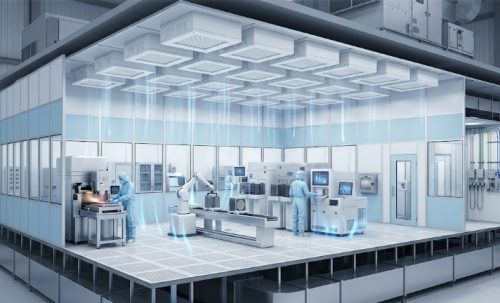
In the microelectronics and semiconductor industries, a single sub-micron particle can compromise an entire wafer lot, leading to catastrophic yield losses. Implementing a robust ISO 5 cleanroom design for microelectronics is not just a regulatory compliance check—it is a critical foundation for operational precision and profitability.
As a leading turnkey cleanroom engineering and manufacturing specialist, we understand the rigorous dynamics of airborne particulate control, ESD management, and environmental stability. Here is a comprehensive breakdown of how we engineer high-performance ISO 5 cleanroom solutions tailored for the next generation of microelectronics manufacturing.
Understanding ISO 5 Cleanroom Requirements for Microelectronics
An ISO 5 cleanroom (equivalent to Class 100 under the old US Federal Standard 209E) demands strict environmental limits. To maintain this environment “in-operation,” the airborne particulate count must not exceed 3,520 particles per cubic meter for particles ≥ 0.5 μm.
For microelectronics facilities, achieving this standard requires focusing on several critical engineering pillars:
- High Air Change Rates (ACR): Typically requiring 240 to 480 air changes per hour to rapidly sweep contaminants away.
- Unidirectional (Laminar) Airflow: Utilizing ceiling-to-floor laminar airflow to ensure particles are immediately directed to low-level return air vents without turbulence.
- FFU Coverage: High ceiling coverage (usually 50% to 70%) using Fan Filter Units integrated with Ultra-Low Particulate Air (ULPA) or High-Efficiency Particulate Air (HEPA) filters.
Key Elements of Our ISO 5 Cleanroom Design Solution
1. Advanced Laminar Airflow & FFU Configuration
To eliminate dead zones where micro-particles can settle, our designs implement a fully optimized ceiling grid matrix. By leveraging top-tier HEPA/ULPA filters with 99.9995% efficiency at 0.12μm, we create a continuous, downward piston-like airflow. This ensures that any contamination generated by personnel or automated machinery is instantly suppressed and evacuated through raised perforated floors or low-wall return air plenums.
2. Anti-Static (ESD) Modular Wall Panels & Flooring
Electrostatic discharge (ESD) can attract microscopic dust particles via electromagnetic forces and permanently damage sensitive integrated circuits (ICs). Our microelectronics cleanroom solutions feature:
- Double-skinned modular sandwich panels with anti-static, chemical-resistant powder coatings.
- Conductive PVC or epoxy terrazzo flooring engineered to safely dissipate static charges into the ground system.
3. Precision HVAC Control (Temperature & Humidity)
Silicon wafers are highly sensitive to thermal expansion and moisture. Our custom HVAC integration maintains strict tolerances, delivering temperature controls within ±0.5°C and relative humidity (RH) within ±3%. This prevents photoresist deformation during photolithography and stops wafer oxidation before it starts.
💡 The Semiconductor Yield Factor:
Even with the best lithography equipment, poor cleanroom pressure control can cause cross-contamination from adjacent ISO 7 or 8 gowning rooms. Our systems utilize automated differential pressure dampers to maintain a steady cascade (+15 Pa relative to ambient), guaranteeing outer air never leaks inward.
ISO 5 Cleanroom Architectural Enclosures
We don’t just engineer the airflow—we manufacture the critical cleanroom components to ensure structural integrity and seamless airtight sealing. Our product integration for microelectronics solutions includes:
| Component | Specifications | Microelectronics Advantage |
|---|---|---|
| Modular Wall Panels | 50mm/70mm thick, Rockwool/Aluminum Honeycomb core | Airtight, flush joints, zero outgassing, high fire resistance. |
| Cleanroom Doors | Flush-fit steel/aluminum doors with drop-down bottom seals | Minimizes air leakage during personnel transit, easy to sanitize. |
| Pass Boxes | Electronic interlocking, integrated UV/HEPA air shower | Safe material transfer between different ISO classes without pressure drops. |
Why Choose Our Turnkey Engineering Solutions?
Designing an ISO 5 cleanroom for microelectronics requires a delicate balance of engineering expertise and high-quality hardware. We offer a true turnkey solution that bridges the gap between architectural layout and mechanical performance:
- End-to-End Compliance: Fully compliant with ISO 14644-1, NEBB, and IEST standards from design through to final testing and certification (IQ/OQ/PQ).
- In-House Manufacturing: We manufacture our own doors, window panels, and air handling components, ensuring perfect dimensional compatibility and cost-efficiency.
- Global Project Experience: Delivering high-tech cleanroom engineering across Southeast Asia, the Middle East, Europe, and Latin America.
Ready to Optimize Your Microelectronics Cleanroom Yield?
Don’t let particulate contamination compromise your high-value semiconductor fabrication. Contact our engineering team today for a tailored ISO 5 Cleanroom Design Consultation and custom budgeting quote.